The universe began in a Big Bang nearly fourteen billion years ago, and has been expanding ever since. But how does the universe expand and what is it expanding into? Sajan Saini explains the existing theories around the Big Bang and what, if anything, lies beyond our universe.
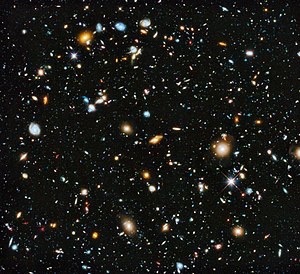
The Hubble Ultra-Deep Field image shows some of the most remote galaxies visible with present technology, each consisting of billions of stars. (Apparent image area about 1/79 that of a full moon)[1]
Age (within Lambda-CDM model)
13.799 ± 0.021 billion years[2]
Diameter
Unknown.[3] Diameter of the observable universe: 8.8×1026 m (28.5 Gpc or 93 Gly)[4]
Mass (ordinary matter)
At least 1053 kg[5]
Average density
4.5 x 10⁻³¹ g/cm3[6]
Average temperature
2.72548 K[7]
Main contents
Ordinary (baryonic) matter (4.9%)
Dark matter (26.8%)
Dark energy (68.3%)[8]
Shape
Flat with only a 0.4% margin of error[9]

 Jesse`s blog